Out-of-band management
Out-of-band management is a requirement when you want to intervene immediately when your network goes down after a failed update, or even worse a cyber incident. Connect directly to every critical server, switch, firewall in your network.
ZPE Systems’s network and infrastructure 3rd generation management solutions reduce management headaches by delivering reliable out-of-band (OOB) management and powerful automation capabilities on a vendor-neutral platform.
What is out-of-band management?
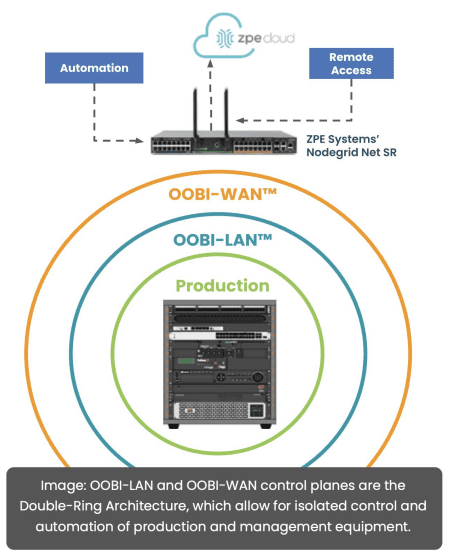
Out-of-band management (OOBM) is a method for IT administrators to securely monitor, manage, and recover network devices (servers, switches, routers) via a dedicated, independent network channel. Unlike in-band management, OOBM remains fully functional even if the main network is down, the operating system is unresponsive, or the device is powered off.
Benefits out-of-band management
- Higher Availability: Ensures 24/7 access to critical infrastructure.
- Reduced Downtime: Allows for immediate, remote remediation of issues, avoiding the need for on-site “truck rolls”
Common use cases include managing data centers, remote offices, and critical network infrastructure where uptime is paramount.
ZPE Systems OOB with automation focus
ZPE’s Nodegrid platform provides physical and software solutions to enable Big Tech’s best practices for network operations. Nodegrid Serial Consoles and Services Routers deliver secure out-of-band (OOB) management access, while the onboard Nodegrid OS hosts VMs and containers for your choice of apps, tools, and automation solutions. The ZPE Cloud management software gives you a bird’s-eye view of every business site where you can perform routine maintenance, deploy automation scripts, or fully rebuild environments to recover from cyberattacks.
Why you should have out-of-band management
Your organization must comply with the NIS2 (Network and Information Security 2) Directive, which is a significant legal framework in Belgium aimed at enhancing cybersecurity. This includes adopting risk management measures tailored to your company’s size, exposure to cyber risks, and the severity of potential incidents. Key measures include technical, operational, and organizational actions to manage and mitigate cybersecurity risks.
The Nodegrid platform enables organizations of all sizes to achieve the operational efficiency and resilience enjoyed by Big Tech, providing benefits like:
- Accelerated deployments. Nodegrid’s multi-function devices run your choice of custom and third-party automation tools, reducing your tech stack while letting you deploy revenue-generating services in hours.
- Unified workloads. Nodegrid unifies infrastructure management, monitoring, and automation workflows with a vendor-neutral orchestrator that decreases complexity and boosts operational efficiency.
- Isolated management infrastructure (IMI). Nodegrid OOB fully segments the management network from production and enables automatic patching, blocking attack movements while locking out the latest threats.
- Reduced error. Nodegrid’s IMI control plane lets you test configurations and automations before pushing them to production while allowing you to instantly undo mistakes, reducing the risk of human error.
- Expedited recovery. Nodegrid IMI lets you quickly deploy an Isolated Recovery Environment to decommission, cleanse, and restore affected gear to accelerate ransomware recovery without paying the ransom.
Use case: Gen 3 OOB and IMI for hyperscale data centers
An out-of-band management network (a.k.a., an isolated management infrastructure, as written by CISA) gives admin access to devices via a fully independent network, removing management interfaces from the production network. This mitigates the risk of human error taking your production network offline while preventing malicious actors from laterally accessing management infrastructure. IMI simplifies and accelerates remediation, and Gen 3 serial consoles offer a drop-in approach to deploying an IMI.
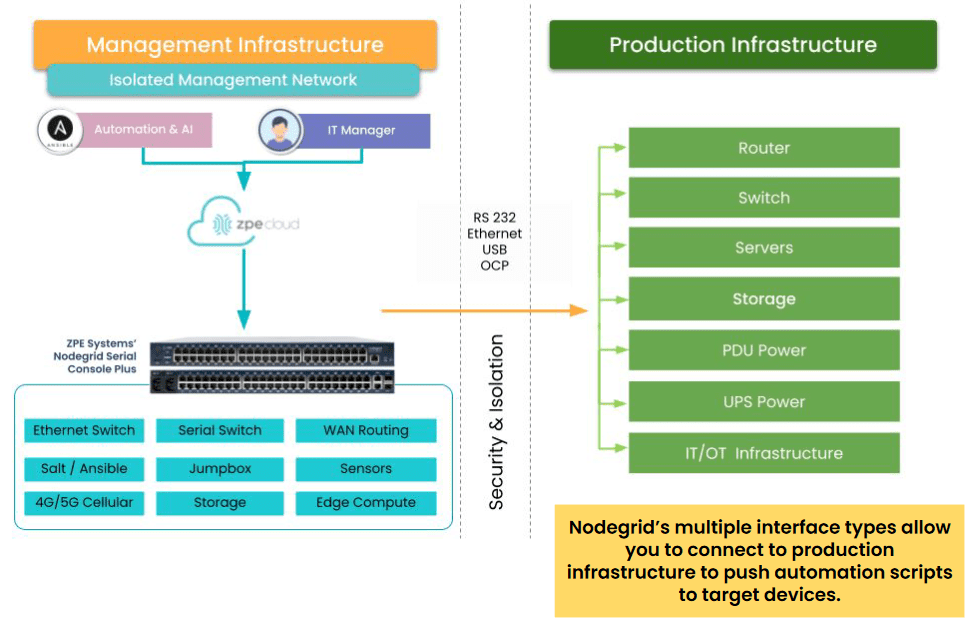
Nodegrid IMI is a CISA-defined best practice for hyperscale data centers because it:
- Provides 24/7 remote access to your vital data center infrastructure, even if your WAN link goes down, so you can troubleshoot and recover without expensive truck rolls.
- Allows you to fight through cyberattacks using full remote access to isolate, cleanse, and recover production gear without exposing yourself.
- Lets you avoid performance impacts on the production network and end-users by performing resource-intensive network orchestration on the IMI’s dedicated management plane.
Use case: Gen 3 OOB and IMI for colocations
Managing colocation deployments often involves hours of on-site work and ongoing maintenance, as well as significant overhauls to adapt to new use cases. Nodegrid’s Gen 3 OOB via IMI is a multi-function device that shrinks the stack to save valuable rack space in colocation deployments. The open Nodegrid OS integrates into any automation, IaC, or DevOps environment for zero-touch deployments and true lights-out management, reducing on-site work and ongoing maintenance. The extensible OS and modular hardware also allow you to address new requirements with code or simple maintenance.
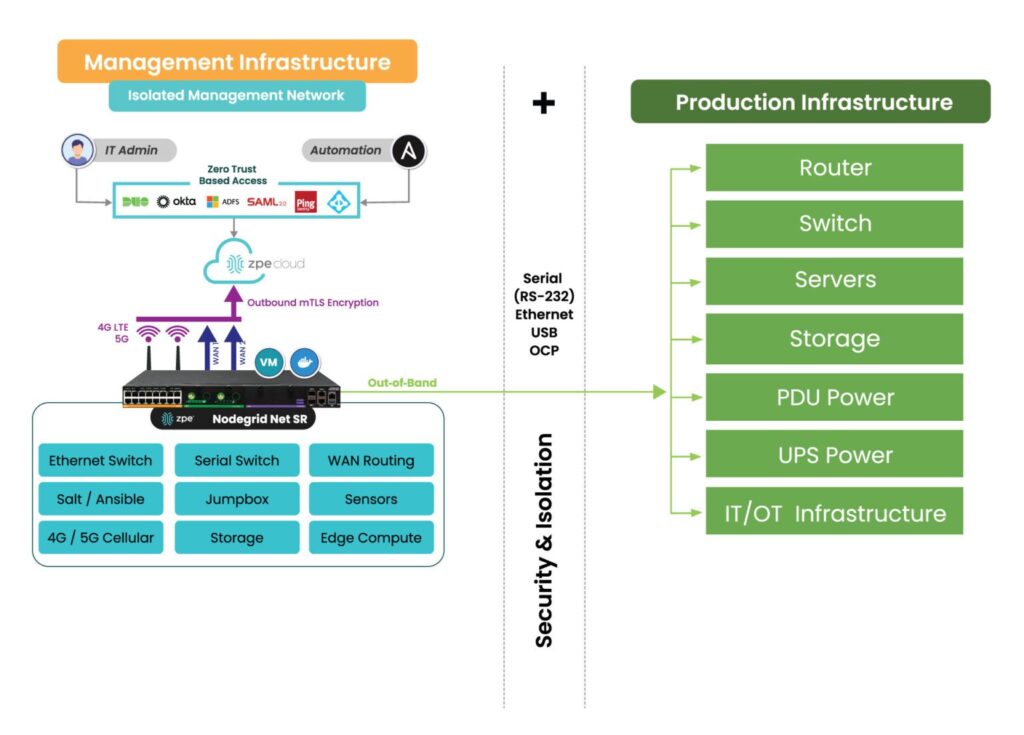
Nodegrid IMI is crucial to colocation data centers because it:
- Enables plug-n-play deployments with a secure environment dedicated to Day 0 – 3 operations.
- Puts operations on autopilot with support for automation, IaC, and DevOps, regardless of your environment, for a true lights-out management approach.
- Allows you to meet changing requirements with the extensible Nodegrid OS and modular hardware that allow you to deploy the apps and services you need, anywhere, anytime.
Use case: Scalable IMI for branch & remote edge
Branch operations have inflated device stacks, complex admin processes, and limited support for automation, spreading lean IT teams too thin. Nodegrid & ZPE Cloud solve these challenges by eliminating single-purpose devices, centralizing administrative control, and enabling automation for any skill level. You get the agility to deploy on demand using a secure platform that scales to the needs of your team and your business.
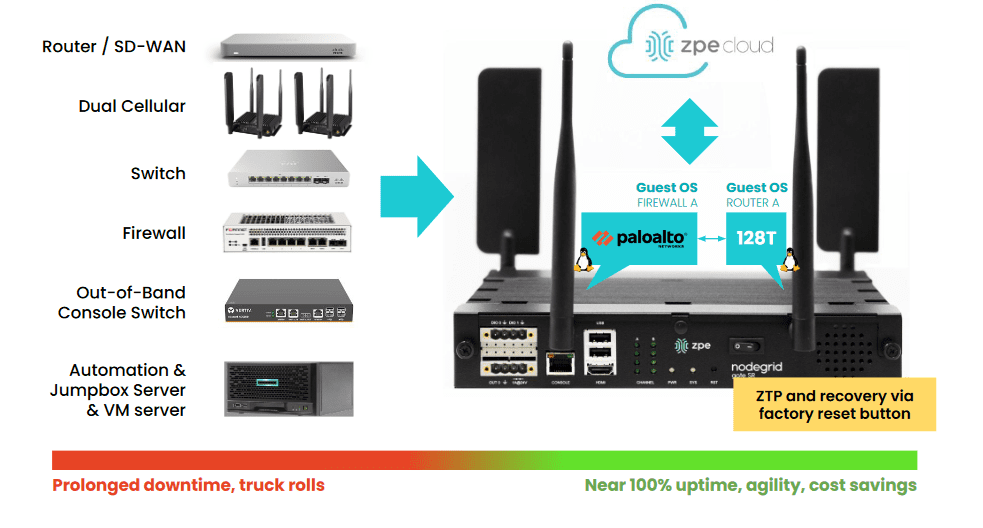
Nodegrid IMI provides consolidation & high availability at the branch and edge by:
- Consolidating 6+ functions into one device to collapse your stack with an agile solution that’s easy to deploy and adaptable to your needs.
- Centralizing access at each site with a single point-of-entry that makes jobs point-and-click simple while minimizing the attack surface.
- Reducing manual and repetitive tasks by allowing you to safely test and deploy automation based on your skill level.
Complete your disaster recovery plan
Whether you’re looking to increase availability & customer satisfaction or have a family weekend free of data center disruptions, we want to help you achieve your goals with better networking.
It’s as easy as deploying Nodegrid Manager on your current system, plugging into the world’s fastest 1U serial console, or connecting to the ultimate all-in-one Nodegrid Services Router.
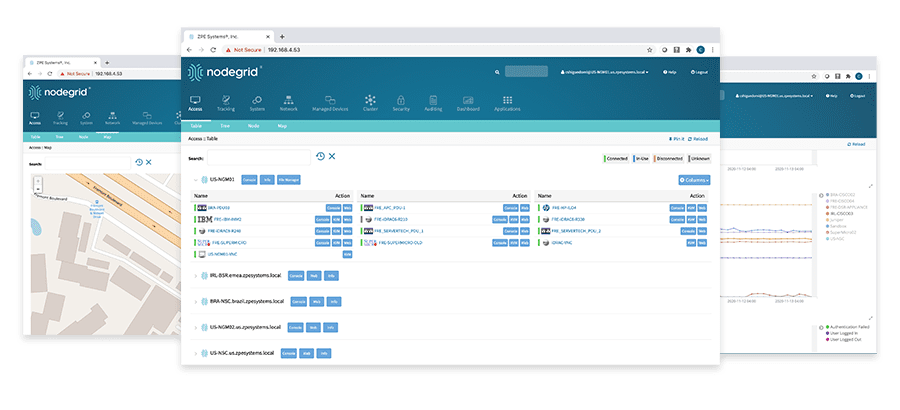
See how ZPE Systems sets you free with Nodegrid
Get a preview of our network and infrastructure management solutions with a free Nodegrid demo.
Frequently asked questions
Check our FAQ section where you can find the first questions that have been asked to us during the last months when discussing a cybersecurity insurance.
Contact usCan cyber insurance cover losses due to human error?
Yes, many cyber insurance policies cover losses resulting from human error, such as accidental data breaches or mis-configurations that lead to security vulnerabilities. This is particularly important since human error remains a common cause of cyber incidents (ICLG IBR).
How does cyber insurance support compliance with regulations like GDPR?
Cyber insurance often includes coverage for legal and regulatory fines associated with data breaches under GDPR. It also supports companies in meeting GDPR requirements by funding risk assessments, security improvements, and incident response activities (ICLG IBR).
How much does comprehensive cyber insurance cost per user?
Comprehensive cyber insurance for larger or higher-risk companies in Belgium can cost between €200 to €400 per user per year. This cost reflects the broader coverage and higher policy limits necessary for more significant risks (Howden Group).
What are the key factors influencing the cost of cyber insurance per user?
The cost is influenced by factors such as the size of the company, industry risk level, existing cybersecurity measures, the scope of coverage (e.g., basic vs. comprehensive), and past incident history. High-risk industries or companies requiring extensive coverage will pay more per user (Howden Group).
What are the main types of cyber incidents covered by cyber insurance?
The main types of incidents covered include data confidentiality breaches, ransomware attacks, business interruption due to cyber incidents, network security failures, and sometimes even state-sponsored cyber attacks (ICLG IBR).
What are the requirements for obtaining cyber insurance in Belgium?
To obtain cyber insurance, Belgian companies typically need to comply with the NIS2 Directive, implement recognized cybersecurity frameworks (like CyFun®), conduct regular security audits, and have robust incident response plans in place (Centre for Cyber security Belgium, ICLG IBR).
What does a basic cyber insurance policy typically cover?
A cyber insurance as a basic policy usually covers data breaches, legal costs, customer notification, credit monitoring services, ransomware payments, and business interruption caused by cyber incidents. It may also include some regulatory fines (Howden Group).
What is cyber insurance?
Cyber insurance is a specialized policy designed to protect businesses from the financial risks associated with cyber incidents, such as data breaches, ransomware attacks, and other forms of cybercrime. It covers costs related to data recovery, legal fees, regulatory fines, and business interruption(Howden Group).
What is the role of regular audits in cyber insurance?
Regular audits, both internal and external, are critical for maintaining compliance with cybersecurity standards and are often required by insurers to validate that the insured company has adequate protections in place. These audits help in assessing vulnerabilities and ensuring that security measures are effective (ICLG IBR).
Why does a Belgian company need cyber insurance?
Belgian companies, especially those with significant turnover, are increasingly targeted by cybercriminals. Cyber insurance provides financial protection and risk management support, helping companies recover from incidents and mitigate the impact on their operations. Compliance with frameworks like NIS2 also makes it essential for certain companies( Centre for Cyber security Belgium, Centre for Cyber security Belgium).